Every term used in the lessons, each with a drawing. For the parts themselves, by number and with a picture of each, see Parts.
- Anti-stud
- The hollow underside of a part, whose walls and tubes grip the studs of the part below.
- Ball joint
- A ball on one part in a socket on another. It bends in every direction and holds by friction.
- Bar
- A rod 3.18 mm thick. It fits a clip, a hollow stud and a minifigure hand.
- Bracket
- A plate with an upright wall on one edge and studs on the face of the wall.
- Brick
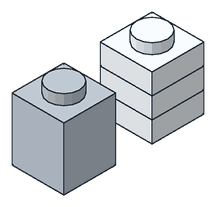
- The tall part, 24 LDU: 4 LDU taller than it is wide.
- Brick with a side stud
- An ordinary 1×1 brick with one more stud on its side, 10 LDU below the top.
- Cancel
- One of the two ways to deal with a leftover half plate: make the space an even number of studs wide, so that two half plates add up to one whole plate.
- Chain
- A source, some plates on edge and a converter lying on its side, ending in a stud that points up or down.
- Clearance
- The 0.1 mm cut from each side of a part so that neighbours slide together. The sums ignore it.
- Click hinge
- A hinge with meshing teeth that holds in steps of 22.5°.
- Clip
- A springy C-shaped grip that holds a bar and lets it turn.
- Collision
- Two parts that would have to occupy the same space. A sum cannot see one.
- Converter
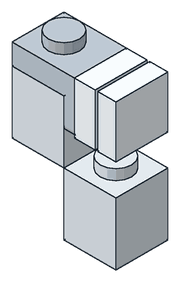
- Any part with a side stud: a brick with a side stud, a headlight brick or a bracket. It turns the direction of building.
- Double clip
- Two clips side by side on one plate, gripping the same bar so the hinge cannot twist.
- Fill
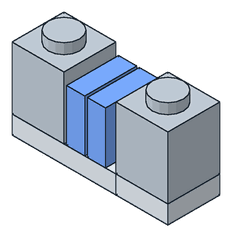
- A stack of parts on their sides that covers a space of a given width.
- Flush
- Ending exactly level with the parts alongside: no step and no gap.
- Gap
- Empty space left where a part stops short of the parts around it.
- Half plate
- 4 LDU, or 1.6 mm: what is left when plates on edge try to fill one stud.
- Half stud
- 10 LDU, or 4 mm: the shift a jumper gives.
- Handle
- A bar moulded onto a part, for a clip to grip.
- Headlight brick
- A 1×1 brick with a stud on one side, set back 4 LDU into the brick.
- Hinge
- A clip on a bar, or a made hinge part, that lets one piece of a model fold against another.
- Illegal connection
- A connection that only holds by bending the plastic. The word comes from a talk by the LEGO designer Jamie Berard.
- Inverted bracket
- A bracket whose wall points up from the plate instead of hanging down.
- Jumper
- A plate two studs long with a single stud in the middle. It shifts what stands on it by half a stud.
- LDU
- The LDraw unit, 0.4 mm: a quarter of the 1.6 mm step that LEGO parts are designed on. A stud is 20, a plate 8, a brick 24.
- LDraw
- The fan-made system of files and programs for drawing LEGO models, started by James Jessiman in 1995. Its parts library is where the geometry on this site comes from.
- Lip
- The small ledge under the side stud of a headlight brick, 4 LDU deep and 4 LDU high.
- Mount face
- The flat face a side stud stands on. Its distance from the centre of the part is written F.
- Offset
- A deliberate shift smaller than one stud or one plate.
- On edge
- A plate turned on its side, so that its 8 LDU thickness runs sideways.
- Panel
- A brick hollowed out to a thin wall and floor, each 4 LDU thick.
- Pitch
- The distance between two side studs, centre to centre. It has to be 20 or 40 LDU for one part to sit across both.
- Pivot
- The line a hinge turns about. On a clip hinge it is 20 LDU out from the stud and 2 LDU above the middle of the plate.
- Plate
- The thin part, 8 LDU tall. Three plates are as tall as one brick.
- Plate with a side stud
- A small part two plates tall with a stud on its side, 6 LDU below the top.
- Proud
- Standing out past the parts alongside.
- Quarter plate
- 2 LDU, or 0.8 mm: what is left when a plate, 8 LDU, stands in the half stud of a jumper, 10 LDU.
- Recess
- The 4 LDU by which the side stud of a headlight brick is sunk into the brick.
- Ring plate
- A 1×1 plate with a ring on its side. The old thin ring and the current thick one differ by a quarter plate each side.
- SNOT
- Studs Not On Top: building with parts turned on their side, upside down or at an angle, instead of stacking upward.
- Side stud
- A stud on a side face of a part instead of on top. What is pressed onto it is turned a quarter turn.
- Side-stud height
- How high the centre of a side stud sits above the underside of its own part, written A. Not the height of a stud itself, which is 4 LDU.
- Slope
- A part with a slanted top. The small one used on this site rises 12 LDU, a plate and a half, over one stud.
- Source
- The upright part with a side stud that a chain starts from.
- Spacer
- A plate on edge between the source and the converter of a chain. Each one adds 8 LDU.
- Stack
- To press one part onto the studs of another, so the model grows upward.
- Step
- The jump from one layer or one stud to the next. Stacked parts can only move a whole plate up or a whole stud across.
- Stud
- The round bump on top of a part. Also the unit of width: stud centres are 20 LDU, or 8 mm, apart.
- Stud column
- The 20 LDU-wide slot that one stud occupies. Dashed lines in the drawings are the edges of stud columns.
- Stud reversal
- Making studs point the opposite way from the rest of the model, for a hull, a ceiling or a wing: building part of it upside down. It is done with a chain.
- Supply
- One of the two ways to deal with a leftover half plate: add one part that is half a plate thick, such as a bracket, so that an odd-width stack comes out to whole studs.
- Technic hole
- The round hole through a Technic brick. It takes a pin, an axle or, tightly, a stud.
- Tile
- A plate with a smooth top and no studs.
- Turntable
- A base with a top that turns freely on it, for rotating in the flat.
- Whole-stud triangle
- A right-angled triangle whose three sides are whole numbers of studs, such as 3, 4 and 5. Its hinges all sit on the grid.
- X and Z
- The two numbers that say where the last stud of a chain ends up, both in LDU and both read off the side view: X sideways from the centre of the source, Z up from its underside.