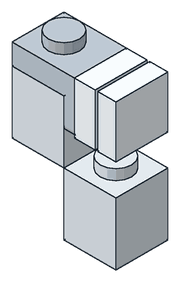
The commonest sideways job is filling a space: a panel in a wall, a strip of floor, a smooth face that must end level with the upright parts beside it. This lesson shows which sideways stacks come out exactly level, and which part to add when they do not.
What a fill is
A fill is a stack of parts lying on their sides, pressed onto a side stud, that has to cover a space of a given width. It is flush when its last face ends exactly on the edge of a stud column, so that the parts standing next to it are level with it.
Each plate lying on its side adds 8 LDU to the stack. The space is counted in studs, 20 LDU each. So the question is always the same: can a number of eights make a number of twenties? Five eights are forty, and so are two twenties, so that one can.

The test
Add up the stack in LDU. If the total is a multiple of 20, the fill is flush. If it is 4 short, it needs one part that is half a plate thick. Lesson 3 shows where that half plate comes from and which parts have one.
Even widths fill with plates alone: five plates are two studs. Odd widths always need one half-plate part.
In a real set
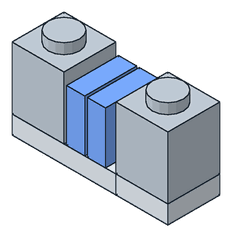
Fiat 500, set 10271, 2020.
The right-hand door has a dark red lining. Three brackets (99781) lie in a row with three inverted brackets (99780) directly on top of them, so their upright walls give two rows of side studs. Three 1 × 3 plates (3623) stand on edge across both rows, and two 1 × 6 tiles (6636) cover the plates.
Bracket wall, plate, tile: one stud exactly. Checked against the LDraw file of the set, a part-by-part copy of LEGO’s building instructions.

A build to try
You need a 1 × 1 bracket, a 1 × 1 plate, a 1 × 1 tile and a 1 × 2 plate to stand everything on.
Press the plate and then the tile onto the wall of the bracket. Run a fingernail from the tile onto whatever stands in the next stud column: there is no step. One stud, filled exactly.