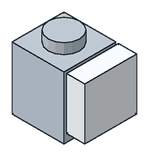
To build sideways you first need a stud that points sideways. The parts that have one are called converters on this site, and they are not interchangeable: the one you pick decides where everything attached to it ends up. This lesson shows what decides it, and the three results you can get.
What a converter is
An ordinary brick has studs on top only. A converter also has a stud on a side face, so a part pressed onto that stud is turned a quarter turn.
There are three kinds. A brick with a side stud is an ordinary brick with one more stud on its side. A headlight brick has its side stud sunk a little way into the brick. A bracket is a plate with a thin upright wall on one edge, and the studs are on the wall.

What decides where the attached part ends up
Two things, and the first is how far out the face is. The attached part is pressed flat against the face around the side stud, so it starts wherever that face is.
On a brick with a side stud the face is the side of the brick: 10 LDU from the centre, exactly on the edge of the stud column. On a headlight brick it is sunk 4 LDU inside that edge. On a bracket the wall puts it 4 LDU outside.
A tile is 8 LDU thick, a whole plate. So its outer face ends 8 outside the column on the first, 4 outside on the second and 12 outside on the third.
The second thing is how high the side stud is. The attached part is centred on the stud, so a tile one stud wide reaches 10 LDU above the centre of the stud and 10 below it. Where the stud sits between the top and the bottom of the converter decides which edge of the tile comes out level.
Three results
Press a tile one stud wide onto the side stud and one of three things happens. In each drawing the converter is blue and the tile is the dashed outline.


Every converter puts the half plate somewhere: under the attached part, above it, or in its own wall. Choosing a converter is choosing where the half plate goes.
In a real set
Tokyo, set 21051, 2020.
The white block with the printed screens is two tall bricks with two side studs (32952), stacked. A printed 1 × 1 tile sits on the upper stud of the top brick. That stud is 10 LDU below the top of the brick, so the tile ends level with the top, the first of the three results.
Checked against the LDraw file of the set, a part-by-part copy of LEGO’s building instructions.

A build to try
You need a 1 × 1 brick with a side stud, a 1 × 1 tile and one plain 1 × 1 brick.
Press the tile onto the side stud and stand the plain brick beside the first one. The tile stands a whole plate proud of the plain brick, and stops half a plate above the table. Those are the two numbers this lesson is about: how far out, and how high.