LEGO parts are designed to stack upward, on a grid that is not square. This lesson shows that grid, names its three lengths, and explains why a part turned on its side stops fitting.
The situation
A wall with two sideways tiles
Here is a short wall. Two of its bricks have a stud on the side, and a tile is pressed onto each of those studs, so the tiles face outward instead of up.
The tiles do not sit flush. Each one stands out from the wall by the thickness of a plate, and stops half a plate short of the floor. Nothing is broken and nothing is forced: the tile and the wall are simply measured in units that do not agree.

Three lengths
The stud
A stud is the round bump on top of a part. Studs are evenly spaced, and the distance from one to the next is the unit of width: a 1×6 plate is six studs long.
The slot that one stud occupies is a stud column. The dashed lines in every drawing on this site are the edges of stud columns.
A flat drawing is a side view, cut through the parts: across the page is across the model, up the page is up. Lengths run from face to face. Where one is measured from the centre of a stud instead, the text says so.

The plate and the brick
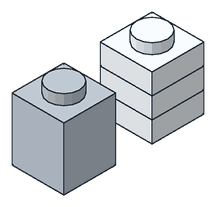
A plate is the thin part and a brick is the tall one. Three plates stacked are exactly as tall as one brick.
A tile is a plate with no studs on top.
The unit: LDU
Millimetres give awkward decimals, so this site measures in LDU, the unit of the LDraw parts library. One LDU is 0.4 mm, which turns every length into a whole number: a stud is 20, a brick is 24 and a plate is 8.
Half a plate, 4, is the fourth length. Where the unit comes from, and why it suits sideways building so well, is the subject of lesson 2.
The rule
A brick on its side
Standing upright, a part is counted in studs across and in plates upward. Turn it on its side and its height becomes its width: it is now measured in plates, 8 LDU each, inside a space measured in studs, 20 LDU each. And 8 does not go into 20.
A brick is 20 LDU wide and 24 tall. Lay it on its side and it is 24 wide: 4 LDU more than the stud column it has to fit into.
That is the whole difficulty of sideways building in one part.

Do it: add up in LDU
To know whether a sideways stack will fit, add up its parts in LDU and compare the total with the space. If the two numbers are equal, the stack ends flush.
That is all a sum can tell you: whether the sizes line up. Whether the parts can join, whether the whole of each part has room, and whether the result holds together are separate checks. Lesson 10 goes through them.


Back to the wall
The tile on the wall at the top of this page is one plate thick, so it stands 8 LDU proud of the wall. Lesson 4 explains the 4 LDU underneath it.

In a real set
Modern House, set 31153, 2024
One strip of the outside wall is a column of eighteen white 1 × 2 bricks with two side studs (11211), each with a 1 × 2 tile (3069b) on its side. A tile is 20 LDU tall and a brick is 24, so every tile ends level with the top of its brick and stops 4 LDU short of the bottom. The designer kept the gaps: they are the grooves between the planks.
Checked against the LDraw file of the set, a part-by-part copy of LEGO’s building instructions.

Watch out
Parts are made slightly small
A 1×2 brick measures 15.8 mm across, not 16. Each side is cut back by 0.1 mm so that neighbouring parts slide together.
The sums on this site use the design sizes and ignore that clearance, and so can you: in an ordinary build it does not add up to a gap you can see.
A stud is half a plate high
A stud rises 4 LDU above its part, about 1.7 mm. That is the same as half a plate, which matters in lesson 3: a half-plate gap is just too small to hide a stud in.
Everything: the sizes
| View | Length | LDU | mm | Note |
|---|---|---|---|---|
| Stud pitch | 20 | 8.0 | 2½ plates | |
| Brick height | 24 | 9.6 | 3 plates | |
| Plate height | 8 | 3.2 | 1 plate | |
| Half plate | 4 | 1.6 | ½ plate | |
| Stud diameter | 12 | 4.8 | As LDraw draws it | |
 | Technic pin, shaft | 12 | 4.8 | Drawn the same as a stud in LDraw; the collar at its base is wider |
 | Technic pin hole | 12 | 4.8 | As LDraw draws it; LEGO’s own part names call it a 4.85 hole |
| Stud height | 4 | ≈1.7 | LDraw draws 1.6 mm; references measure 1.6 to 1.8 | |
 | Bar diameter | 8 | 3.18 | Fits clips, hollow studs and minifigure hands |
| Side clearance | 0.25 | 0.1 | Per side; none vertically | |
| Jumper offset | 10 | 4.0 | Half a stud |