One stud is two plates and a half. That half plate, 4 LDU or 1.6 mm, is what a sideways part misses by, and most sideways techniques are a way to supply it or to cancel it.
The situation
A slot one stud wide
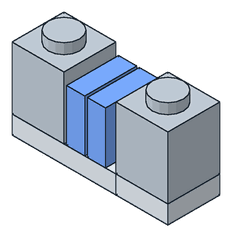
Two bricks stand one stud apart on a plate. Stand plates on edge in the slot between them: two go in, a third does not, and a sliver of space is left over.
The sliver is 4 LDU wide: half the thickness of a plate.
The rule
The leftover has a name on this site: the half plate. It is the fourth length from lesson 1, and it is the number to remember first. Lesson 7 adds two more, the half stud and the quarter plate.
Even widths work, odd widths never do
Fill a space with plates on edge and nothing else, and whether a half plate is left over depends only on the width of the space in studs. Two studs are exactly five plates, so a space an even number of studs wide fills with plates alone.
A space an odd number of studs wide always leaves half a plate over, however many plates you add.
Where to find a half plate
The wall of a bracket
To fill an odd-width space you need one part that is half a plate thick. No such plate exists, but several common parts have a feature that is exactly 4 LDU.
A bracket is a plate with an upright wall on one edge, and studs on the face of that wall. The wall is 4 LDU thick and hangs outside the plate’s footprint.
It is the part builders reach for first.

The recess of a headlight brick
A headlight brick is a 1×1 brick with a stud on one side. That stud does not sit on the surface: it is set back 4 LDU into the brick.
Anything attached to it therefore sits half a plate further in than it would on an ordinary side-stud brick.

A brick turned on its side
Lesson 1 showed that a brick is 4 LDU taller than it is wide. Turned sideways, that difference is a half plate you get for free.

Do it
Supply the half plate
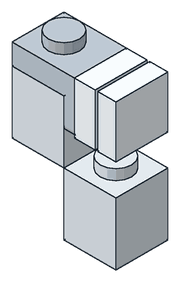
The space is one stud wide, 20 LDU. A plate and a tile on edge make 16. A bracket’s wall adds the missing 4, and the tile’s face lands exactly on the edge of the next stud column.
Cancel the half plate
Two half plates make one whole plate. If you can make the space two studs wide instead of one, the two leftovers join into a fifth plate and the stack fills exactly, with no special part at all.

A real build: the red slope
Three small slopes in a row can make one unbroken slope. A small slope rises 12 LDU over its one stud of length, so each slope has to sit 12 LDU higher than the one before it. Twelve is a plate and a half: plates supply the eight, and a headlight brick supplies the four.

On headlight bricks, one lying on its back
The first slope sits on a headlight brick standing upright, 24 LDU above the table. A second headlight brick lies on its back beside it, its top stud pushed into the square hole in the back of the first. Lying down, its side stud points up, and the face around that stud is 20 LDU above the table: 4 lower than the top of the first brick.
Two plates on that stud lift the second slope to 36. The third slope sits on a plain brick, on a third headlight brick whose side stud plugs into the underside of the one lying down.

The same slope, built as a column
Turn the idea on its side. Stack a plate with a side stud, a headlight brick and another plate with a side stud, and mount the slopes sideways on plates set on edge: three plates at the bottom, two in the middle, none at the top.
The slope is identical. Here the half plate comes from the side stud of the headlight brick, which is set back 4 LDU from the side studs above and below it.

A third way: two headlight bricks in the column
Swap the parts of the column round: a headlight brick at the bottom and at the top, and the plate with a side stud between them. Now the plates on edge are three, one and none.
This time two parts are set back and one is not, and the steps still come out the same. Three builds, one slope: what matters is the 4 LDU, not which part supplies it.

In a real set
Modern House, set 31153, 2024
At the foot of the wall with the tiled strip, two dark grey inverted brackets, two studs tall (99207), stand in the base. On the studs of their upright walls a round plate (6141) and a 1 × 2 plate (3023) stand on edge, and a 1 × 2 tile (3069b) is pressed over both.
The face of the tile lands on the edge of the next stud column. Checked against the LDraw file of the set, a part-by-part copy of LEGO’s building instructions.

Try it
Build a sideways stack from bricks, plates and half-plate parts, and see whether it ends on the edge of a stud column.
Watch out
Not every bracket wall is half a plate
Most brackets have a 4 LDU wall, but the 2×2 bracket 3956 has a wall a full plate thick. Use it by mistake and the stack ends half a plate too far out.

The half plate you did not ask for
On a brick with a side stud, the stud sits nearer the top than the bottom. A tile attached to it ends level with the top of the brick and stops 4 LDU above the floor.
That gap is a half plate too. Lesson 4 shows which parts leave it and which do not.

Everything: parts with a half plate in them
| Part | Number | Where the half plate is |
|---|---|---|
 Bracket 1×1 – 1×1 | 36841 | Upright wall, 4 LDU |
 Bracket 1×1 – 1×1, inverted | 36840 | Upright wall, 4 LDU |
 Bracket 1×1 – 1×2 | 79389 | Upright wall, 4 LDU |
 Bracket 1×1 – 1×2, inverted | 73825 | Upright wall, 4 LDU |
 Headlight brick | 4070 | Stud recessed 4 LDU; lip 4 LDU deep and 4 high |
 Brick 1×1, on its side | 3005 | 24 tall less 20 wide |
 Panel 1×2×1 | 4865b | Wall and floor 4 LDU thick |